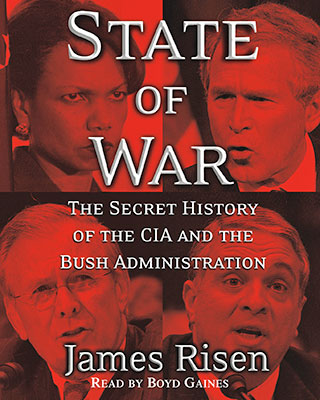
State of War the Secret History of the Cia and the Bush Administration Review

by James Risen
Jan 2006
from TheGuardian Website
This is an edited extract from 'State of War,' by James Risen,
published by The Costless Press.
In an extract from his explosive new book, New York Times reporter James Risen reveals the bungles and miscalculations that led to a spectacular intelligence fiasco.
George Bush insists that Iran must non be immune to develop nuclear weapons.
So why, six years ago, did the CIA give the Iranians blueprints to build a bomb?
She had probably done this a dozen times before. Modern digital technology had made clandestine communications with overseas agents seem routine.
Dorsum in the cold war, contacting a secret amanuensis in Moscow or Beijing was a unsafe, labour-intensive process that could take days or even weeks. Merely by 2004, information technology was possible to send loftier-speed, encrypted letters directly and instantaneously from CIA headquarters to agents in the field who were equipped with modest, covert personal communications devices.
And so the officer at CIA headquarters assigned to handle communications with the agency's spies in Islamic republic of iran probably didn't think twice when she began her latest download. With a few simple commands, she sent a secret data catamenia to one of the Iranian agents in the CIA'due south spy network. Just as she had washed so many times earlier. Only this fourth dimension, the ease and speed of the engineering betrayed her.
The CIA officer had fabricated a disastrous fault. She had sent information to one Iranian agent that exposed an entire spy network; the data could be used to identify virtually every spy the CIA had inside Islamic republic of iran. Error piled on mistake. Equally the CIA later learned, the Iranian who received the download was a double agent. The agent quickly turned the data over to Iranian security officials, and it enabled them to "roll upwards" the CIA'south network throughout Iran. CIA sources say that several of the Iranian agents were arrested and jailed, while the fates of some of the others is still unknown. This espionage disaster, of course, was non reported. It left the CIA virtually blind in Iran, unable to provide any significant intelligence on one of the most disquisitional bug facing the US - whether Tehran was about to go nuclear. In fact, just equally President Bush and his aides were making the case in 2004 and 2005 that Islamic republic of iran was moving chop-chop to develop nuclear weapons, the American intelligence customs found itself unable to provide the evidence to back up the assistants's public arguments.
On the heels of the CIA's failure to provide accurate pre-war intelligence on Iraq's declared weapons of mass destruction, the agency was once again clueless in the Middle East.
In the jump of 2005, in the wake of the CIA's Iranian disaster, Porter Goss, its new director, told President Bush-league in a White Firm briefing that the CIA really didn't know how close Iran was to becoming a nuclear power. But it'south worse than that. Deep in the bowels of the CIA, someone must be nervously, but very privately, wondering:
"Whatever happened to those nuclear blueprints we gave to the Iranians?"
The story dates back to the Clinton administration and February 2000, when one frightened Russian scientist walked Vienna's winter streets.
The Russian had skilful reason to exist afraid. He was walking around Vienna with blueprints for a nuclear bomb. To be precise, he was conveying technical designs for a TBA 480 loftier-voltage block, otherwise known as a "firing set", for a Russian-designed nuclear weapon. He held in his hands the cognition needed to create a perfect implosion that could trigger a nuclear chain reaction inside a pocket-sized spherical core.
It was one of the greatest engineering secrets in the earth, providing the solution to 1 of a scattering of problems that separated nuclear powers such as the United States and Russian federation from rogue countries such every bit Iran that were drastic to join the nuclear lodge but had so far fallen short. The Russian, who had defected to the U.s. years before, still couldn't believe the orders he had received from CIA headquarters.
The CIA had given him the nuclear blueprints and then sent him to Vienna to sell them - or but give them - to the Iranian representatives to the International Atomic Energy Agency (IAEA).
With the Russian doing its behest, the CIA appeared to exist nigh to help Iran leapfrog one of the last remaining engineering hurdles blocking its path to a nuclear weapon.
The dangerous irony was non lost on the Russian - the IAEA was an international organization created to restrict the spread of nuclear applied science. The Russian was a nuclear engineer in the pay of the CIA, which had arranged for him to get an American citizen and funded him to the tune of $5,000 a month. Information technology seemed like easy money, with few strings attached. Until now...
The CIA was placing him on the forepart line of a plan that seemed to be completely at odds with the interests of the US, and it had taken a lot of persuading by his CIA example officer to convince him to get through with what appeared to be a rogue operation. The instance officer worked difficult to convince him - even though he had doubts almost the programme every bit well. Every bit he was sweet-talking the Russian into flight to Vienna, the case officer wondered whether he was involved in an illegal covert action.
Should he expect to be hauled before a congressional committee and grilled considering he was the officeholder who helped give nuclear blueprints to Iran?
The lawmaking name for this operation was Merlin; to the officer, that seemed like a wry tip-off that zippo near this programme was what it appeared to be. He did his best to hide his concerns from his Russian agent. The Russian's consignment from the CIA was to pose as an unemployed and greedy scientist who was willing to sell his soul - and the secrets of the atomic flop - to the highest applicant. By hook or by cheat, the CIA told him, he was to go the nuclear blueprints to the Iranians. They would speedily recognize their value and rush them dorsum to their superiors in Tehran. The plan had been laid out for the defector during a CIA-financed trip to San Francisco, where he had meetings with CIA officers and nuclear experts mixed in with leisurely wine-tasting trips to Sonoma County.
In a luxurious San Francisco hotel room, a senior CIA official involved in the operation talked the Russian through the details of the plan. He brought in experts from one of the national laboratories to get over the blueprints that he was supposed to requite the Iranians. The senior CIA officer could see that the Russian was nervous, and and so he tried to downplay the significance of what they were request him to do.
He said the CIA was mounting the operation simply to notice out where the Iranians were with their nuclear program. This was only an intelligence-gathering effort, the CIA officer said, non an illegal attempt to give Islamic republic of iran the bomb.
He suggested that the Iranians already had the engineering science he was going to hand over to them. It was all a game. Nothing too serious. On newspaper, Merlin was supposed to stunt the development of Tehran'southward nuclear program past sending Iran'south weapons experts down the incorrect technical path. The CIA believed that one time the Iranians had the blueprints and studied them, they would believe the designs were usable and so would start to build an cantlet bomb based on the flawed designs.
Merely Tehran would go a big surprise when its scientists tried to explode their new bomb. Instead of a mushroom cloud, the Iranian scientists would witness a disappointing fizzle. The Iranian nuclear programme would suffer a humiliating setback, and Tehran's goal of becoming a nuclear power would have been delayed by several years.
In the concurrently, the CIA, past watching Iran'south reaction to the blueprints, would take gained a wealth of data about the status of Iran's weapons plan, which has been shrouded in secrecy. The Russian studied the blueprints the CIA had given him.
Within minutes of beingness handed the designs, he had identified a flaw.
"This isn't right," he told the CIA officers gathered around the hotel room. "There is something wrong."
His comments prompted stony looks, just no straight answers from the CIA men.
No i in the meeting seemed surprised past the Russian's assertion that the blueprints didn't await quite right, merely no one wanted to enlighten him further on the matter, either. In fact, the CIA example officeholder who was the Russian'due south personal handler had been stunned by his statement.
During a pause, he took the senior CIA officer bated.
"He wasn't supposed to know that," the CIA case officer told his superior. "He wasn't supposed to observe a flaw."
"Don't worry," the senior CIA officeholder calmly replied. "It doesn't matter."
The CIA instance officer couldn't believe the senior CIA officer's answer, simply he managed to go on his fears from the Russian, and connected to train him for his mission. After their trip to San Francisco, the instance officer handed the Russian a sealed envelope with the nuclear blueprints inside. He was told non to open the envelope under any circumstances. He was to follow the CIA'due south instructions to find the Iranians and give them the envelope with the documents inside. Keep it uncomplicated, and go out of Vienna safe and alive, the Russian was told.
But the defector had his ain ideas about how he might play that game. The CIA had discovered that a high-ranking Iranian official would be travelling to Vienna and visiting the Iranian mission to the IAEA, and so the agency decided to send the Russian to Vienna at the same time. It was hoped that he could brand contact with either the Iranian representative to the IAEA or the company from Tehran. In Vienna, however, the Russian unsealed the envelope with the nuclear blueprints and included a personal letter of his own to the Iranians.
No matter what the CIA told him, he was going to hedge his bets. There was obviously something wrong with the blueprints - so he decided to mention that fact to the Iranians in his letter of the alphabet. They would certainly find flaws for themselves, and if he didn't tell them first, they would never desire to deal with him once again. The Russian was thus alert the Iranians as carefully equally he could that there was a flaw somewhere in the nuclear blueprints, and he could assistance them observe information technology. At the aforementioned time, he was nevertheless going through with the CIA's operation in the merely fashion he thought would work. The Russian soon establish nineteen Heinstrasse, a v-storey office and apartment building with a flat, pale green and biscuit facade in a tranquility, slightly downward-at-heel neighborhood in Vienna'south north terminate. Amongst the list of Austrian tenants, there was one simple line: "PM/Iran."
The Iranians clearly didn't want publicity.
An Austrian postman helped him. As the Russian stood by, the postman opened the building door and dropped off the mail. The Russian followed suit; he realized that he could leave his bundle without really having to talk to anyone. He slipped through the front end door, and hurriedly shoved his envelope through the inner-door slot at the Iranian office. The Russian fled the mission without existence seen. He was deeply relieved that he had made the hand-off without having to come face up to face with a real alive Iranian. He flew dorsum to the US without being detected by either Austrian security or, more importantly, Iranian intelligence. Just days afterwards the Russian dropped off his package at the Iranian mission, the National Security Agency ( The Russian scientist's fears about the performance seemed well founded.
He was the front man for what may accept been one of the nigh reckless operations in the modern history of the CIA, 1 that may have helped put nuclear weapons in the easily of a charter member of what President George Due west Bush has called the "axis of evil". Operation Merlin has been ane of the nigh closely guarded secrets in the Clinton and Bush administrations.
It's not clear who originally came up with the thought, but the programme was starting time approved past Clinton . Subsequently the Russian scientist's fateful trip to Vienna, however, the Merlin operation was endorsed by the Bush assistants, possibly with an eye toward repeating it confronting Democratic people's republic of korea or other unsafe states. Several old CIA officials say that the theory behind Merlin - handing over tainted weapon designs to confound ane of America's adversaries - is a trick that has been used many times in by operations, stretching back to the cold war.
But in previous cases, such "Trojan horse" operations involved conventional weapons; none of the one-time officials had ever heard of the CIA attempting to deport this kind of high-risk operation with designs for a nuclear bomb.
The former officials also said these kind of programs must be closely monitored by senior CIA managers in guild to control the menstruation of information to the adversary. If mishandled, they could hands assistance an enemy accelerate its weapons development.
That may be what happened with Merlin. Iran has spent about 20 years trying to develop nuclear weapons, and in the procedure has created a stiff base of operations of sophisticated scientists knowledgeable enough to spot flaws in nuclear blueprints. Tehran also obtained nuclear blueprints from the network of Pakistani scientist Abdul Qadeer Khan, and so already had workable blueprints against which to compare the designs obtained from the CIA.
Nuclear experts say that they would thus exist able to extract valuable information from the blueprints while ignoring the flaws.
"If [the flaw] is bad plenty," warned a nuclear weapons skilful with the IAEA, "they will find information technology quite quickly. That would exist my fearfulness"
Source: https://www.bibliotecapleyades.net/sociopolitica/sociopol_cia21.htm
0 Response to "State of War the Secret History of the Cia and the Bush Administration Review"
Post a Comment