Weld With 220v 6000 Watts Continuous Sine Inverter Welding
What Size Generator for Welding?
Sometimes it's just more practical to tackle welding jobs in the field instead of in the comfort of your shop.
Today's generators and welders are more powerful and portable, making it easier than ever to weld at remote locations, but what size generator for welding is right for you?
Jump to:
- Size Generator for Welder
- Tips: Welding with a Generator
- Generators for Welders
How to Size a Generator for Welding
Because welders are complicated, and the manufacturers use different designs and components to achieve rated output levels (and even how they rate output varies), I don't recommend that you use the amperage output rating to size a generator.
The generator doesn't care how many amps the welder can develop. What matters is how many watts the welder consumes to create its welding amperage.
I'll take you through the calculations, but for those in a hurry, this chart will give you a general ballpark idea of how much generator wattage you'll need for welding.
Generator Sizing Chart for Welders
| Welder Amperage | Minimum Generator Size | Recommended Generator Size |
|---|---|---|
| Up to 100A | 3000 watts | 4500 watts |
| 120–160A | 4500 watts | 6500 watts |
| 180–200A | 6500 watts | 8000 watts |
| 210–250A | 10000 watts | 13000 watts |
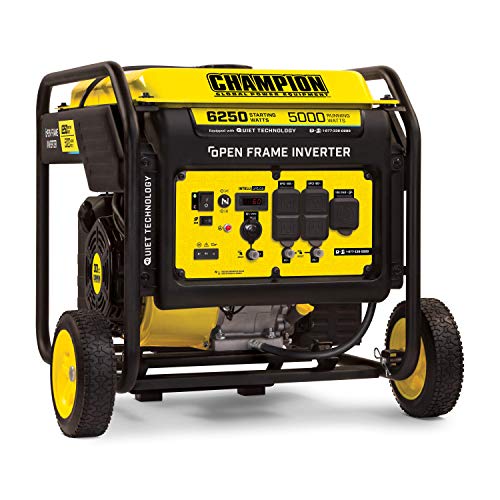
I like this 6250-watt generator to power any size 120V welder, and this larger model for 240V welders up to 250A.
You'll find generator output usually expressed in watts. Here's the basic formula we'll use:
Watts = Volts x Amps
For example, this tells you a generator rated at 4800 watts powering a 120-volt device supplies 40 amps of current (4800 watts = 120 volts x 40 amps), and if capable of 240-volt output, that same generator provides 20 amps (4800 watts = 240 volts x 20 amps).
Convert output rated in kVa (kilovolt-ampere) to watts by multiplying by 800. For example, a generator rated at 9 kVa multiplied by 800 converts to 7200 watts.
Look for two output ratings for a generator. One for a steady ongoing load known as the operating, or running watts.
Most generators can also handle a brief output spike that occurs when a motor (or a welder) starts. Typically 25-30% higher than the running figure, this is the start-up or surge watt rating.
Most generators include some wattage value in their model name. You'll want to check if it represents running or surge watts, as this varies by manufacturer.
Sizing a generator to power a welder starts with knowing the maximum watts the welder will draw. Then you'll know the minimum watts your welder needs to operate at full capability.
How Many Watts Does Your Welder Use?
It's rare to find total watts listed for welders, but a few manufacturers provide helpful minimum generator size recommendations.

While not all manufacturers bother to provide this information, you can calculate watts using voltage and amperage figures from the owner's manual or the data plate on the welder.
Use the Manufacturer's Voltage Rating
While you'll find generators rated for 120 and/or 240 volts, some manufacturers rate their welders at 110, 115, or 230 volts.
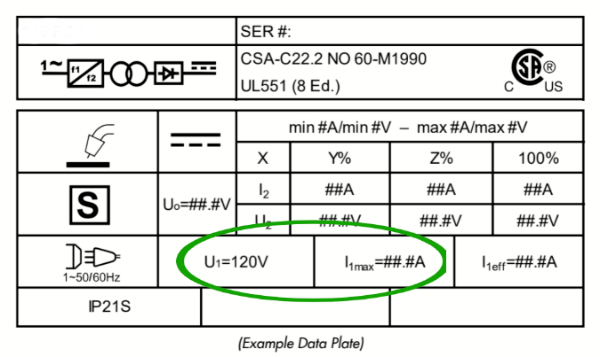
For accuracy, it's best to use the manufacturer's number listed as U₁ on the data plate. This is the voltage they used to rate the machine and measure amperage values.
Get the Right Amperage Value
Depending on the welder, you may find a handful of different amp ratings, or just one.
Look for the I1max number. It's the best rating to use because it represents the maximum rated supply current. You may see this referred to as the maximum "inrush" or "surge" current draw on startup.
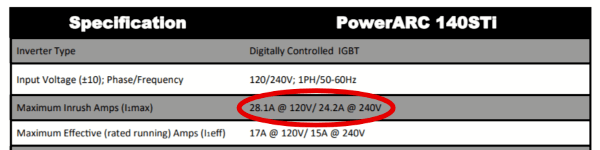
Multiply the I1max amperage by the manufacturer's voltage rating to get the maximum watts required for your welding machine.
Using the welder specifications from above:
24.2 amps x 240 volts = 5808 maximum watts
The manufacturer, Everlast, recommends a minimum 6000-watt surge generator in the 140 STi owner's manual.
The I1eff amp number is a thermal rating taking into account rated duty cycle limits (idle time) and heat buildup to size dedicated building circuits. Without adjustment, it's too low to calculate maximum watts.
When manufacturers give both ratings, I find the I1max is normally 1.7 to 2.2 times greater than the I1eff rating.
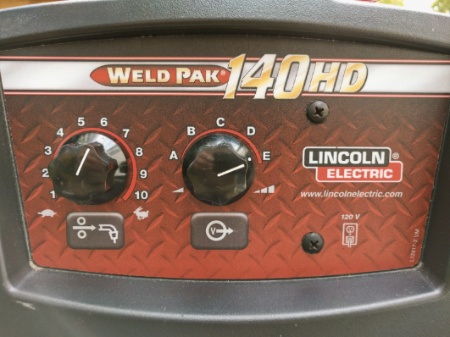
Some data plates show just an I 1 or "recommended circuit breaker" information, as on a Lincoln 140.
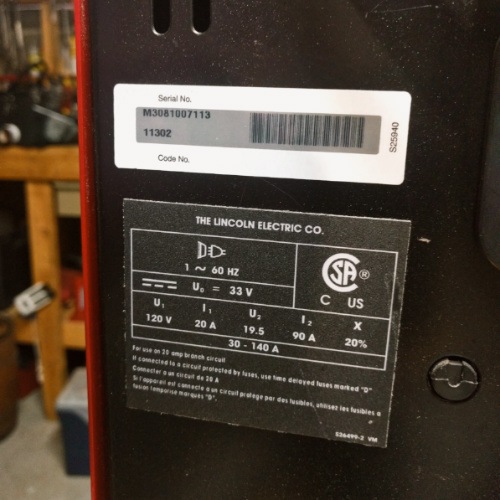
Using the specs Lincoln gives us:
20 amps x 120 volts = 2400 watts
But I've seen Lincoln representatives say this welder requires, at a minimum, a 3000-watt generator. And 3000 watts divided by 120 volts gives us 25 amps, which is likely closer to the I1max rating for this machine.
The recommended circuit breaker size may be too small to calculate full operating wattage. A properly operating circuit breaker is designed with a time delay and probably wouldn't trip because of a brief 25 amp surge.
But this would cause a problem on a generator with a surge rating of 2400 watts.
Finally, don't make the mistake of using output amperage figures such as I 2 or duty cycle amperage.
Adjustments to Consider
Before deciding on what size generator to run your welder, here are a few more things to consider.
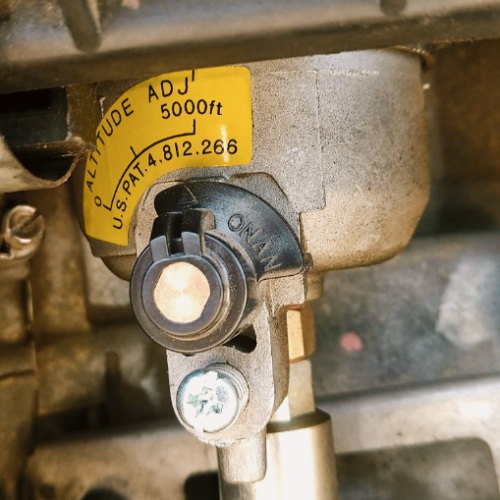
Derate for High Altitude Operation
Thinning of air means less power at greater altitudes.
According to one generator manufacturer:
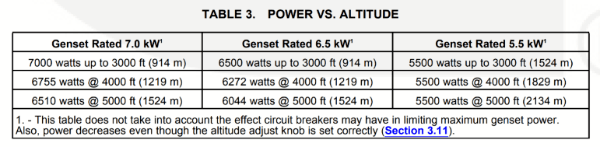
"…air density decreases as altitude increases, causing rated genset engine power to decrease—approximately 3.5 percent each increase of 1000 feet (305 m) (Table 3). It may be necessary to run fewer appliances at higher altitudes."
Cummins Onan – Generator Operator's Manual
These Onan generators include an altitude adjustment control. High-altitude kits are available for many generator models.
Don't Forget Accessory Equipment
You may need to operate work lights, fans, and air compressors while welding, and this adds to your total wattage requirement.
Grinders and chop saws can use up to 1800 watts each. This isn't an issue if you're working solo. But in a team situation, sizing the generator for twice the welder's maximum watts will minimize the impact on your weld of other tools starting up.
Here are power requirements for common devices:
| Appliance | Running Watts | Starting Watts |
|---|---|---|
| Coffee Maker | 1750 | 0 |
| 625W Microwave | 625 | 800 |
| Single 60W equivalent CFL bulb | 15 | 0 |
| Radio | 50-200 | 0 |
| Room Air Conditioner: 10,000 BTU | 1500 | 2200 |
| Small Appliance | 200 | 1700 |
| 8in. Bench Grinder | 1400 | 2500 |
| Pressure Washer: 1 HP | 1200 | 3600 |
| 7-1/4in. Circular Saw | 1400 | 2300 |
| Electric Chain Saw: 14in. Bar, 2 HP | 1100 | 0 |
| 10in. Table Saw | 1800 | 4500 |
| Drill: 3/8in., 4 Amps | 440 | 600 |
| Drill: 1/2in., 5.4 Amps | 600 | 900 |
| Portable Heater (Kerosene, Diesel Fuel): 90,000 BTU | 500 | 725 |
| Battery Charger: 60 Amp with 250 Amp Boost | 1500/5750 | 0 |
| Laptop | 65 | 0 |
| LCD Computer Monitor | 25 | 0 |
| Inkjet Printer | 15 | 0 |
| Tablet | 12 | 0 |
| Cell Phone Charger | 10 | 0 |
"Dirty" vs. Clean Power Generators for Welders
Welder internal power sources fall into two distinct design categories, each handling incoming current in different ways to create weldable power output.
Traditional Transformer-Based Welders
With large transformers made from copper and aluminum, these heavy power sources change AC input current into low voltage/high amperage DC power for welding.
Very reliable and not sensitive to dirty power, traditional welders work well with any generator.
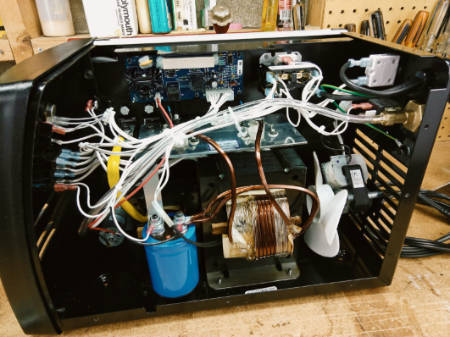
Inverter-Style Welders
With technology to create efficient welding power with much smaller transformers, inverter welders often weigh less than half of traditional welders. They achieve a very stable output thanks to capacitors that store high voltages.
But these sophisticated electronics need quality input power.
Many generators create excessive voltage and frequency fluctuations known as "dirty power". It's measured as a percentage of Total Harmonic Distortion, or THD. Dirty power can quickly destroy sensitive electronics or shorten service life with cumulative damage.
Particularly sensitive are older inverter welders using metal-oxide-semiconductor field-effect transistor (MOSFET) technology.
Newer machines based on insulated-gate bipolar transistors (IGBT) fare better, but still require a clean power generator with 5% or less THD.
Here's a video showing a Lincoln 180 MIG welder running on a 7250-watt generator:
Generators for Welders
Compact and reliable, a modern portable generator will power your welder and other tools at any job site, and keep your lights and refrigerator on at home during power outages.
Conventional Generators for Welders
Essentially a motor-driven AC alternator, traditional general-purpose generators make power in a single step. Spinning the alternator at 3600 RPM creates 120 volts with a frequency of 60 Hz.
Any variation to this speed causes voltage and frequency to fluctuate, resulting in harmonic distortion. Sure, the governor will try to maintain a steady RPM, but any significant change in the load will cause a brief spike up or down.
While traditional transformer-based welders work well with conventional generators, the power does not meet clean standards. This style of generator should not power inverter-based welders needing 5% or less THD.
Preview
Factory Tested
Remote Start
Dual Fuel
Generator
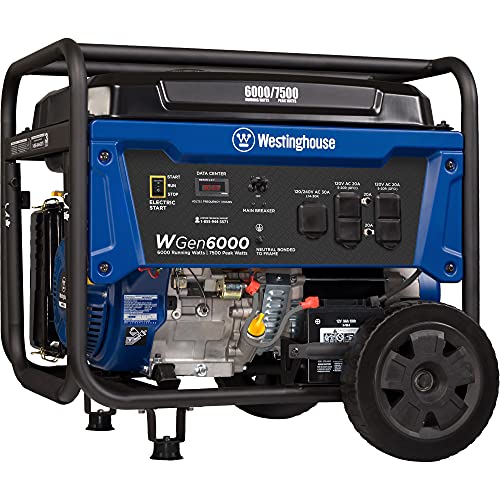
Westinghouse WGen6000 Portable Generator
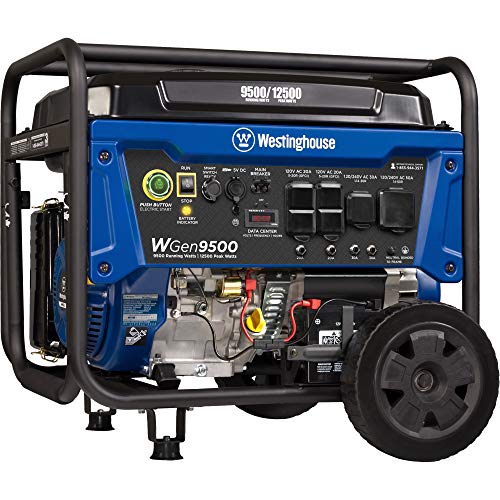
Westinghouse WGen9500 Portable Generator
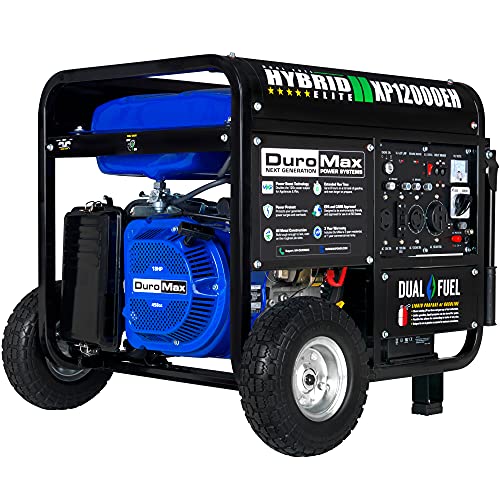
DuroMax XP12000EH Dual Fuel Generator
Highlights
For 120V and small 240V transformer welders. Each unit factory tested, Push-button electric start, VFT Data Center displays volt output, frequency, and lifetime hours
For all 120V and many 240V transformer welders up to 250A. Factory Tested, Remote Start Key Fob, Long-Lasting Cast Iron Sleeve With Automatic Low Oil Shutdown and Digital Hour Meter
For all 120V and many 240V transformer welders up to 250A. Runs on gas or propane. EPA and CARB approved emissions. All-metal construction.
Outlets
(4) 120V GFCI 5-20R, (1) Transfer Switch Ready L14-30R 120/240V, (2) USB
(4) 120V GFCI 5-20R, (1) Transfer Switch Ready L14-30R 120/240V twist-lock, (1) 120/240V 14-50R, (2) USB ports
(2) 120V 20A GFCI, (1) 120V 30A, (1) 240V 30A, (1) 240V 50A
Run Time @ 50% Load (Est.)
Factory Tested
Preview
Generator
Westinghouse WGen6000 Portable Generator
Highlights
For 120V and small 240V transformer welders. Each unit factory tested, Push-button electric start, VFT Data Center displays volt output, frequency, and lifetime hours
Outlets
(4) 120V GFCI 5-20R, (1) Transfer Switch Ready L14-30R 120/240V, (2) USB
Run Time @ 50% Load (Est.)
Remote Start
Preview
Generator
Westinghouse WGen9500 Portable Generator
Highlights
For all 120V and many 240V transformer welders up to 250A. Factory Tested, Remote Start Key Fob, Long-Lasting Cast Iron Sleeve With Automatic Low Oil Shutdown and Digital Hour Meter
Outlets
(4) 120V GFCI 5-20R, (1) Transfer Switch Ready L14-30R 120/240V twist-lock, (1) 120/240V 14-50R, (2) USB ports
Run Time @ 50% Load (Est.)
Dual Fuel
Preview
Generator
DuroMax XP12000EH Dual Fuel Generator
Highlights
For all 120V and many 240V transformer welders up to 250A. Runs on gas or propane. EPA and CARB approved emissions. All-metal construction.
Outlets
(2) 120V 20A GFCI, (1) 120V 30A, (1) 240V 30A, (1) 240V 50A
Run Time @ 50% Load (Est.)
Inverter Generators for Welders
It turns out that the same inverter technology that gives welders a stable output also helps generators make clean power in three steps:
- Generate high frequency AC with an engine-driven alternator
- Convert AC to DC current
- Invert DC current into a lower and very stable AC supply current
Starting with high energy, the AC current allows the inverter more control over the final output. The result is a stable sine wave with low THD (under 5%) that is perfect for both inverter and conventional welders, along with other sensitive electronics.
Preview
Ultra-Quiet
Full Outlet Bank

Digital Smart Gauge
Generator
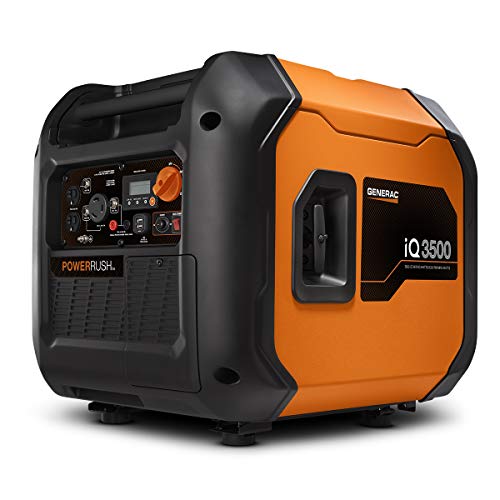
Generac 7127 iQ3500-3500 Watt Portable Inverter Generator
Powerhorse Portable 4000 Watt Generator
Champion Power 6250W Inverter Generator
Highlights
For many small 120V welders up to 100A. Electric start with included battery, parallel ready, smart gauge displays wattage and run time remaining.
For many small 120V welders up to 100A. Clean, reliable electricity. 100% copper winding allows continuous operation without overheating. Automatic voltage regulator with voltmeter and low oil shutdown.
For small 120V welders up to 165A. Quiet running clean power. 3-year warranty. Monitor voltage, frequency and operating hours from Intelligauge
Outlets
(1) 120V 50A 14-50R, (1) 120V 30A TT-30R (RV), (2) USB
(8) 120V, 20A, (1) 120/240V 30A, (1) 12V DC
(1) 120/240V 30A (L14-30R), (4) GFCI 120V 20A (5-20R), (1) 12V DC
Start
Electric / Recoil Pull Start
Run Time @ 50% Load (Est.)
Ultra-Quiet
Preview
Generator
Generac 7127 iQ3500-3500 Watt Portable Inverter Generator
Highlights
For many small 120V welders up to 100A. Electric start with included battery, parallel ready, smart gauge displays wattage and run time remaining.
Outlets
(1) 120V 50A 14-50R, (1) 120V 30A TT-30R (RV), (2) USB
Start
Electric / Recoil Pull Start
Run Time @ 50% Load (Est.)
Full Outlet Bank
Preview
Generator
Powerhorse Portable 4000 Watt Generator
Highlights
For many small 120V welders up to 100A. Clean, reliable electricity. 100% copper winding allows continuous operation without overheating. Automatic voltage regulator with voltmeter and low oil shutdown.
Outlets
(8) 120V, 20A, (1) 120/240V 30A, (1) 12V DC
Run Time @ 50% Load (Est.)
Digital Smart Gauge
Preview
Generator
Champion Power 6250W Inverter Generator
Highlights
For small 120V welders up to 165A. Quiet running clean power. 3-year warranty. Monitor voltage, frequency and operating hours from Intelligauge
Outlets
(1) 120/240V 30A (L14-30R), (4) GFCI 120V 20A (5-20R), (1) 12V DC
Run Time @ 50% Load (Est.)
Preview
Compact Power
40A Outlet

Generator
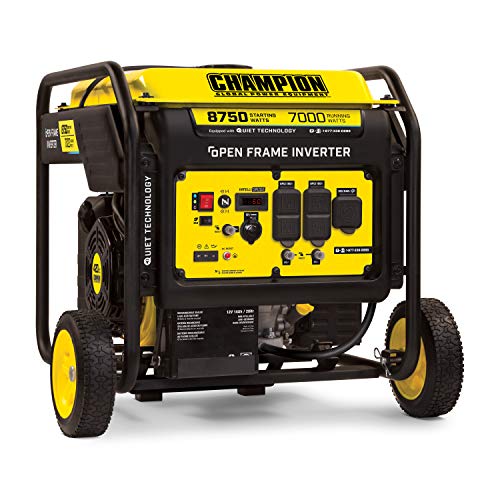
Champion 8750 Watt Inverter Generator
Powerhorse 13000W Portable Generator
Highlights
For 120V and small 240V welders, including inverter. Clean power digital hybrid inverter generator. EPA certified and CARB compliant. Small footprint for output.
For 120V and many 240V welders up to 250A, including inverter. 8 clean-power outlets. 100% copper-wound generator head allows continuous operation without overheating.
Outlets
(1) 120/240V 30A Locking (L14-30R), (4) GFCI 120V 20A (5-20R), (1) 12V DC Automotive
(4) 120V 20A, (1) 120V 30A locking, (1) 120/240V 30A locking, (1) 120/240V 40A, (1) 12V DC
Run Time @ 50% Load (Est.)
Compact Power
Preview
Generator
Champion 8750 Watt Inverter Generator
Highlights
For 120V and small 240V welders, including inverter. Clean power digital hybrid inverter generator. EPA certified and CARB compliant. Small footprint for output.
Outlets
(1) 120/240V 30A Locking (L14-30R), (4) GFCI 120V 20A (5-20R), (1) 12V DC Automotive
Run Time @ 50% Load (Est.)
40A Outlet
Preview
Generator
Powerhorse 13000W Portable Generator
Highlights
For 120V and many 240V welders up to 250A, including inverter. 8 clean-power outlets. 100% copper-wound generator head allows continuous operation without overheating.
Outlets
(4) 120V 20A, (1) 120V 30A locking, (1) 120/240V 30A locking, (1) 120/240V 40A, (1) 12V DC
Run Time @ 50% Load (Est.)
Tips for Welding with a Generator
- Size the generator to your welder:
- Know your welders wattage requirement for full operation. From the data plate, multiply I1max (max amps) x U₁ (volts) = maximum watts.
- Include watts for accessory items that you might need while you weld: lights, fans, etc.
- Allow for 3.5% of power loss per every 1000 feet of altitude.
- Choose a generator capable of producing at least 25-30% more watts than you need for best results.
- Undersized generators can have larger voltage and frequency spikes. This is hard on the generator and welder. It also makes welding more difficult.
- A generator running at 50-60% capacity will handle load fluctuations better than one running at 90%+.
- Starting and Shutdown: Unplug your welder before starting or shutting down the generator.
- Auto-Idle: Disable off any fuel saving feature so the generator always operates at full speed while connected to the welder.
- Fuel: Keep topped up with fresh fuel. You never want the generator to stop running while connected to the welder—especially while you're running a bead.
- Maintenance: Keep the generator operating properly. Don't operate your welder on a generator that isn't running well.
- Power/Extension Cords: Don't use cords that are undersized or in poor condition. Here's how to size a welder extension cord.

Will a 3000 watt generator run a welder?
A 3000-watt generator with 120-volt output can generate 25 amps of current (Amps = Watts/Volts). While many 120V welders draw more amps at full power startup, a small welder with 90 to 100-amp output should work.
Will a 5000 watt generator run a welder?
Yes, a 5000-watt generator is ideal for 120V welders that draw less than 40 amps at startup, which includes most welders up to 160 amps. But most 240V machines need more than 5000 watts to run at full capacity.
What size generator to run a 140 amp welder?
Many welders rated for 140-amp output will draw less than 30 amps at startup, but some need nearly 40 amps.
To be safe, get the I1max (max amps) rating and multiply it by the voltage for the maximum watts. Expect to need 3600 to 4800 watts for full operation of a 140-amp welder.
Conclusion
Some of you are researching what size generator to use for an existing welder, and others have a generator and want to know what size of a welder it can handle.
Either way, you can now make an informed decision based on the minimum wattage required to operate a welder at full capacity.
While it's ideal to power your welder with a generator having 30-50% more capacity than you need, you may decide that a welder/generator combo allowing only 80% of welder capacity is right for you.
You'll make the call based on your situation. Sizing a generator for welding forces us to balance power, price, and portability.
Source: https://welditu.com/gear/tools/what-size-generator-welding/
0 Response to "Weld With 220v 6000 Watts Continuous Sine Inverter Welding"
Post a Comment